Monday, November 15, 2010

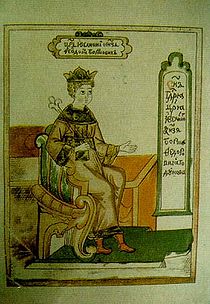
Vasilij IV

Vasilij IV Shuisky was born on September 22, 1552. He was Tsar between 1606 and 1610. He became the Tsar after the assassination of False Dmitriy by rioters who stormed the Kremlin.
The False Dmitriy was so titled because the people suspected him of being from Poland, not Russian, although he claimed to be the son of Ivan the Terrible. His real name might have been Grigory Otrepyev, but this is uncertain. When he died his ashes were shot from a cannon in the direction of Poland.
Vasilij IV Shuisky is a decedent (20th generation) of Rurik the Viking. He was a leading boyar during the reign of both Feodor I and Boris Godunov.
Tsar Godunov ordered Shuisky to secretly investigate the death of Tsarevich Dmitry Ivanovich, the youngest son of Ivan the Terrible. Shuisky found that Ivanovich had killed himself. When the False Dmitriy rose to power, Shuisky supported him. Shuisky went against his findings and proclaimed the False Dmitiriy as the “real” Dmitry. This lead to the False Dmitiriy's assassination which allowed Shuisky to make an attempt at Tsar. He was recognized by his followers however the general public failed to ever officially recognize him as the Tsar of Russia. During his reign, he signed an alliance with Sweden to try to prevent further Polish involvement in Russia. Eventually, after four years of very little power and ruling over Russia, he was ousted out of power by two of his former followers, Princes Vorotynsky and Mstislavsky. He became a monk and was eventually transported to a castle, the castle of Gostynin, which was near Warsaw and died there as a prisoner in 1612.
The Time of Troubles:
The Time of Troubles in Russia lasted from 1598 to 1613. During this time period, many rulers attempted to control Russia after the last true ruler, Feodor Ivanovich, died in 1598. Ivanovich failed to sire children and continue the current dynasty, the Rurik Dynasty, which in turn lead to the Time of Troubles because there was no true leader.
After the death of Feodor, his brother-in-law, Boris Godunov, was elected to be the successor to Ivanovich by the Russian Great National Assembly. Godunov was very close to Ivanovich. He played the role as advisor to Ivanovich during Ivanovich's reign. Godunov would go on to rule for only a short time, from 1598 – 1605. Godunov was a weak ruler and unfortunately had to rule during years of bad harvest and famine, particularly in 1601-1603. His administration distributed food to the poor only in Moscow, leading to those who were not from Moscow to flock to the city, causing more problems.
In 1603, an individual that became known as the False Dmitri, claimed to be the rightful heir of the throne to Russia because he was related to the late Ivan the Terrible. The  False Dmitri in actually came from modern-day Poland, known at the time as the Polish-Lithuanian Commonwealth. Polish forces later appeared in Russia, about 4,000 troops. The King of the Polish-Lithuanian Commonwealth, Sigismund III Vasa, did not approve of the invasion and interference in Russian affairs. However, some Polish officials supported the False Dmitri and gave him money in hopes to reap rewards later.
The False Dmitri reigned for about a year starting with the death of Godunov. In May of 1606, the False Dmitri was killed along with 2,000 other Poles who supported him as the Rurik Prince, Vasilij IV Shuisky, took power. (See notes above.) After Shuisky signed an alliance with Sweden, the King of the Polish-Lithuanian Commonwealth, Sigismund III Vasa, decided that this alliance was a threat and approved of internal interference with the Russian government.
This brought on another False Dmitri, claiming again to be the rightful heir and ruler of Russia as a decedent of Ivan the Terrible. He had the support of the Polish-Lithuanian government officials called “magnates”.
The Polish-Lithuanian Commonwealth crossed into Russia in 1609 and laid siege to a strategic Russian city, the city of Smolensk. This siege lasted two years, with the Russians eventually losing. The Swedish assisted the Russians militarily, however, with the Polish-Lithuanian victory in the Battle of Klushino, the Polish eventually made it to the Kremlin and assumed command. It was not the False Dmitri II who assumed the throne, but rather the son of the Polish King, Wladyslaw, was placed in the position of power. The people of Moscow allowed this because they were allowed to keep the Russian Orthodox Church if they cooperated and allowed this transition to occur.
Unfortunately for the Polish-Lithuanian Commonwealth, King Sigismund II Vasa decided against this compromise and assumed the throne of Russia for himself. He attempted to force Roman Catholicism upon the Russian people. This backfired greatly because the Russian people despised Catholicism and now the Polish, invoking riots and mini-battles. Tens of thousands of Russians died between 1609 and 1611. In March of 1611, Moscow was set on fire and about 7,000 citizens of Moscow died.
Eventually, two leaders, Kuzma Minin and Prince Pozharsky, lead the Russian people to independence from the Polish-Lithuanian Commonwealth. In November of 1612, the Kremlin was taken back and the Polish-Lithuanian army retreated.
Michael Romanov was elected in February 1613 by the Russian National Assembly. This lead to the powerful Romanov Dynasty that would reign in Russia from 1613 to 1696.

Dimitri the False


(1581-1606)

Dimitri Ioannovich was Tsar of Russia from July 21, 1605 until his death in May 17, 1606. He had the tittle of Dimitri II but his real name is reported to have been Grigory Otrepyev.   

 He was one of three people who during the Time of Troubles claimed to be the youngest son of Ivan the Terrible, Tsarevitch Dimitri Ivanovich, who it was rumored escaped assassination which had been ordered by his uncle Boris Godunov in 1591.

Dimitri claimed that his mother was the widow of Tsar Ivan and had given him to a doctor to save him from assassination. The doctor had hidden him in a Russian monastery and after the doctor died he fled to Russia where he worked as a teacher before he was in service to a noblemen. Many who knew Tsar Ivan thought Dimitri looked like the Tsar's son. 

Several powerful noblemen decided to support him against Tsar Boris Godunov. The king of Poland decided to support Dimitri but not give any aid to help him gain the thrown. He also recived the support of the Jesuits. Dimitri converted to Roman Catholicism in 1604 and convinced the papal nuncio Claudio Rangoni to back his claim.

Some of the Russian boyars claimed to accept Dimitri's claim to have a reason to not pay taxes to Tsar Boris.

 Dimitri had a large number of followers, a small army and the support of the commonwealth magnate who gave him 3500 soldiers from their private armies. In June of 1604 he rode into Russia with the added support of the southern Cossacks. Dimitri and his army fought two battles, wining the first but lost the second. On April 13, 1605 news arrived of of Tsar Borris' death.

Russian troops switched sides and on June 1,the newly crowned tsar, Feodor II, was imprisoned and later killed. July 21st Dimitri was crowned tsar.

Dimitri planned to introduce a series of political and economical reforms. He brought back Yuri's Day; when serfs were allowed to move to another lord, to make their lives easier.

In foriegn affairs, Dimitri tried to make an alliancew with the Polish-Lithuanian Connonwealth and the Roman Pope. He planned war against the Ottoman Empire and ordered the mass production of firearms. He refered to himself as the "Emperor of Russia".

To show appreciation of his Polish supporters he converted Russia to Catholicism after gaining the throne. This angered the Russian Orthodox Church and increased support of his enemies. The boyars, began ploting against him, accusing him of spreading Roman Catholicism and sodomy.

On May, 17 1606 the kremlin was stormed by Dimitri's emiemies. Demitri tried to escape through a window but broke his leg in the fall. He was shot dead by the time he hit the ground. His body was put on display and then cremated, the ashes were shot from a cannon towards Poland. Demitri's reign only lasted 10 monthes. Vasili Shuisky became the new Tsar.


Feodor the II

                                   
After the death of his father, Feodor II, or Theodore II, succeeded as Tsar of Russia and had large shoes to fill to accomplish as much as his predisessor.
                Not much is known about Theodore II reighn because it was so short lived. He reigned from april 1605 to july 20, 1605. It is presumed Theodore was an intelligent man due to the extensive education his father made sure he received. He was the first Russian to make a map of his country. His father  ensured that Theodore was left heavily guarded with trusted friends and officials. This however was not enough. Two short months after being crowned Tsar, he and his mother were found strangled. The culprit was False Dimitriy I. This was one of three men that claimed to be the youngest son of Ivan the Terrible. He arranged for the death of Theodore and his mother to look as if they were poisioned. However, with their bodies on display, it was evident there was a violent struggle. False Dimitry I succeeded Theodore II and was crowned tsar in July 1605.  
                As a young 16 year old tsar, Theodore was never given the chance to follow in his father’s footsteps. This may have been a blessing in disquise because the years that followed after Theodor’s death were recorded in history as, Times of Troubles.

Boris Godunov

Boris Godunov


There were few people that sparked the interest and gained the trust of Ivan the terrible. One of those few men was Boris Godunov. From the time he was a trusted confidant in the Russian court until his death in 1605, Boris managed to bring about positive change and a balanced structure to the Russian government.
Born Boris Fyodorovich Godunov in c.1551, he was a member of an ancient Russian family that migrated to Muscovy in the 14th century. Boris gained a position in Ivan the Terrible’s court as an archer of the guard.  Ivan chose Irene, Boris’ sister to be the bride for his son, Theodore. On his deathbed, Ivan appointed Boris as co-guardian and successor for his son Theodore. After Ivan’s death, Boris used his connections to slyly make decisions that helped to ensure him becoming the next Tsar of Russia. It was speculated he had Theodore’s other guardian killed to eliminate any competition to the throne.
Under the Tsar Theodore, Boris exercised his full power of being a member of the court. The competency level of Theodore was evidently lacking which is how Boris managed to inadvertently rule Russia even before he was elected Tsar. Boris was an intelligent man who looked around and realized that the west was prospering and growing through the means of trade and if Russia did not take advantage of this, they would hastily fall behind. Boris exempted English merchants from tolls as a means of encouraging trade. This proved to be a wise decision. Trade was opened with the west. The Tatar and Finnic tribes proved to be a threat, so Boris , as a way to protect against them, built towns and fortresses which civilized the borders of Moscovy. Boris also worked vigorously at recolonizing Siberia.
                The Muscovite church was strongly under the influence of the metropolitan of Kiev. It was because of Boris that the Muscovite church was granted its patriarchate which led to its emancipation from the Kievs. Of the many accomplishment of Boris his most important reform was the Ukaz in 1587. This law, summed up, was a way of keeping the poor man down.  It prohibited peasants from transferring from one land owner to another. They were literally binded to the soil. They could not go with another land owner who may pay them more.
                All this was accomplished by Boris while only holding the title of Sluga. While this was an extraordinary title, he still was not Tsar yet. He did not become Tsar until the death of Theodore on January 7, 1598. Boris was unanimously elected Tsar on February 21, and officially crowned Tsar on September 1, 1598.
                He was very popular and well liked in the first years of his reign. Boris realized Russia was not intellectually as inclined as the West, so he imported foreign teachers. He was the first Tsar to ever do this and also the first to send young Russians to study abroad. He was also the first Tsar to allow Lutherans to build churches in Russia. These were all prominent accomplishments that encouraged the advancement of Russia.
                As powerful as he was, Boris was not above falling victim to paranoia of being overthrown. Due to this uneasiness, he would not allow his greatest boyars to marry. He also encouraged a Gestapo like system where he used informants to report anyone acting or talking suspicious.  When the informants “found” someone, they were punished without just cause. These acts began to hurt his popularity and eventually led to Boris not being considered a successful Tsar.
                Boris suddenly died on April 13, 1605. He left only one son, Theodore II who succeeded Boris as Tsar.

Feodor Ivanovich I

Feodor Ivanovich I

Feodor Ivanovich I was born on May 31, 1557 to Ivan the Terrible and his wife, Anastasiya Romanovna. He came into power after the death of his father in 1584. Although Feodor was the middle son, he became first in line to the throne after the death of his oldest brother, Ivan Ivanovich. His father did not have the utmost confidence in his ability to rule the country which is why Ivan instilled a regency council in order to help guide his incompetent son. In this council were five trusted boyards. One being Feodor’s brother-in-law Boris Godunov.
            Not only was Feodor an incompetent ruler who many believed to be mentally retarded, he also did not have much luck in bearing children either. He married Irina Feodorovna Godunova in 1580. Twelve years later they had a daughter that only lived two years. He had no other children.
            Feodor was a very religious person and spent more time in prayer than he did fulfilling the duties of tsar. He had little interest in expanding on the accomplishments of his father. He closed trade with England almost as soon as he was crowned. Despite Queen Elizabeth’s efforts to keep an ambassador in Russia, Feodor showed no interest and refused.
            As incompetent as Feodor was, there were several positive strides made during his reign. These were in no way attributed to Feodor, but to his appointed guardian, Boris Godunov. Feodor left most of the decision making up to Boris during his reign. This is why it is no surprise that after Feodor was stabbed to death, Boris was unanimously elected as tsar.
            In comparison to his power hungry father, Feodor was ignorant, incompetent, and a disappointment to the progression of Russian expansion. This is exactly how he went down in history.

Ivan the IV (The Terrible)


Early Life:       
Ivan Vasilyevich was born on August 25th 1530 in Kolomenskskoye near Moscow and at the age of three he was proclaimed the grand prince of Moscow. Ivan was the son of Grand Prince Vasily III of Moscow, and was mothered by Vasily’s second wife Yelena Glinskaya whom which ruled in Ivans name following his father’s death until her death in 1538. Since Ivan was too young to rule from 1538 to 1547 there was a bloody strife between the Boyars for power. Which gave Ivan a lifelong dislike and mistrust for the Boyars?

Early Reform:
            On January 16th 1547 Ivan was crowned Tsar of Russia and one month later he married Anastasiya Romanovna the great aunt that would become the Great Romanov Dynasty. One of the first things Ivan did was reform and reorganize the Central and local administrations. Along with making the Orthodox a driving force in his political agenda. In 1550 a new legal code was drawn up to replace the one gating back to 1497. Russia’s central administration was also reorganized into departments each in charge of a function of the state. The conditions of the military was also improved and Generals where promoted on merit rather than by noble birth. Government also became very self Governing with administrators being elected by the gentry.
            The main reason for all of these reforms was to limit the amount of power the Boyars and Aristocracy of the Princes and give power to the gentry who where dependent on the Tsar. All of these reforms took place under the supposed “chosen council” that was made up of the Tsars favorites, but the councils influence waned after Ivan’s Wife died in 1560 because at that time in his life Ivan’s views and entraouge changed.
            Most of Ivan’s reign was plagued by war Muscovite Rulers where always concerned about the Tatars so from 1547to 1550 there were unsuccessful campaigns against the Khanate of Kazan on the Volga River But then in 1552 Ivan was finally able to take the city then in 1556 Khanate of Astrakhan that sets at the mouth of the Volga River was annexed into the Russian empire and from that point on that made the Volga a Russian river and secured a trade route via the Caspian Sea.
The Livonian War:
            A concern for Russia all through history has been being land locked so after the Volga was secured Ivan prepared for a campaign to push to the Baltic sea because he felt that free trade with Europe depended on him having access to the Baltic sea. So in 1558 he launched an assault on the country of Livonia to try and push to the Baltic Sea. The war started off well for Ivan in fact he crushed the Livonians and in 1560 the Livonian made there last stand at the battle of Ermes in August of 1560 but then the tide turned as Lithuania Poland and Sweden all became allies to fight off the Russian invasion. Then to make matters worse for Ivan the Poles and Lithuanians went on the offensive and crossed into Russia in 1580 after recapturing all of Livonia. In 1582 Ivan saw that the situation was grim and asked the pope to intervene so an Armistice was signed forcing Russia to give up all of Livonia and also to give up some of its towns on the Gulf of Finland. So after 24 years of conflict Ivan had nothing to show for his conquest of Livonia.  
The Oprichnina:
            The Oprichnina is a dark stain during the reign of Ivan the IV he felt that he had lost the Livonian war because he was undermined and betrayed by the hereditary nobility so he started a campaign of terror that would last seven years one example of this is in 1570 Ivan led his troops against the city of Novgorod destroyed it and executed several thousand of its inhabtints. Boyars that Ivan felt were plotting against his he would have publicly tortured then executed but ironically Ivan sent to different monasteries Memorials for more than three thousand of his victims not because he felt remorse but because he was concerned for their soul. The Opichnina lasted from 1565-1572 and cast doubt on Ivan mental stability of that time.
The last years:
            In his last years Ivan still expressed an interest in wanting to open trade with Europe especially England and even was willing to marry an English noble women to make it happen. In the 1570’s he married five times in a nine year period and in 1581 Ivan the IV murdered his son Ivan in a fit of rage leaving only his Dimwitted son Feodor to take the throne and set in motion the period that would be known as the Time of Troubles in Russia and the extinction of the Rurik Dynasty after his son Feodor’s death. Ivan the IV died on March 18th 1584 in Moscow leaving behind a bloody trail of warfare and deranged executions. It is for these reasons he goes down in history as Ivan the Terrible.


Vasili III

 Vasili III of Moscow was the Grand Prince of Moscow after his father, Ivan III.  He reigned from 1503-1533. 
The majority of Vasili’s time spent during reign was consolidating his father’s gains.  One of his greatest personal achievements were the annexation of the last remaining autonomous land areas which included Pskov, Volokoamsk, and Ryazan.  Prior to this annexation these areas had freedom from external authority but now took authority from Vasili III and his country. 
            Vasili III married his wife, Solomonia Saburova, in his early twenties.  In 1526, over twenty years into their marriage, they had still not produced any heirs to the throne.  This prompted his wife to consult sorcerers to help remedy this problem.  This did not work which led Vasili to consult with the boyars.  He told them that he did not trust his brothers to handle Russia’s affairs.  They then suggested he take a new wife.  This is what he did, despite obvious opposition from the clergy.  Vasili then married Princess Elena Glinskaya.  They then proceeded to produce two sons, Ivan IV and Yuri.  It is rumored that just months after their divorce Vasili’s first wife, Solomonia, had a son while in a convent that she had been confined to after the divorce.

          
  While hunting in 1533 Vasili felt a pain in his hip which was a result of abscess.  Doctors were unable to stop the infection which led Vasili to believe his time was short.  He then ordered he be taken to Moscow and asked to be made a monk before his death.  He passed away at midnight on December 4, 1533.